Shop › Forums › Cortado Contact Microphone Forum › Cortado FAQ & Support › Cortado as a Boundary Mic › Reply To: Cortado as a Boundary Mic
I ended up ditching the box. I swear this makes no sense – none – but: put the circuit in the box: noisy and low-signal. Put the circuit near the box (like, next to, but not touching): noisy and low signal. Move the circuit further away from the box: NOISE DROPS, SIGNAL RISES.
I swear to you I am not making this up. I swear. I discovered the latter bit by accident. I can only assume there is actually some sort of weird cable magic going on that … doesn’t make a lot of sense either. But I’m going with it.
As to the soldering questions: yeah, everything was as described, and I went through (before seeing this) and basically discovered the ground issues on my own – but fixing them changed nothing. (And yes, my little leads off the disc were shielded the entire time, and so on.)
I realise, again, for the record, that this makes absolutely no sense.
MYSTERIES OF SCIENCE, I guess? Or perhaps capacitance in the case. Maybe there’s just Something Odd about the case plastic.
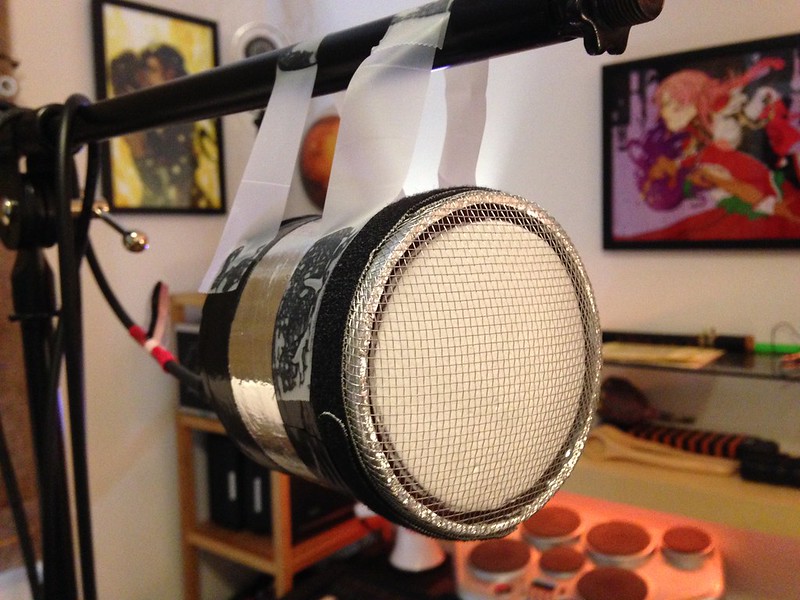
Anyway, out of desperation, I changed tack pretty hard, ditched the modular idea (sadness!) and just decided to build a large diaphragm crystal microphone all in one package. It looks a lot like your Tin Can Microphone but is meaningfully different in that there’s no cone, and no can, even if it looks like a can. 😀
I AM NOT DONE trying the heavier materials though, because the tone I got on the clear plastic from Boeing Surplus back in the day – whatever it might be – was really nice. And I’ve got one more circuit I can experiment with. I may try the modular solution again, with another, no-unknown-plastics/purely metal box.
Here’s a writeup on the new design, with lots of pictures, one of which being this: